
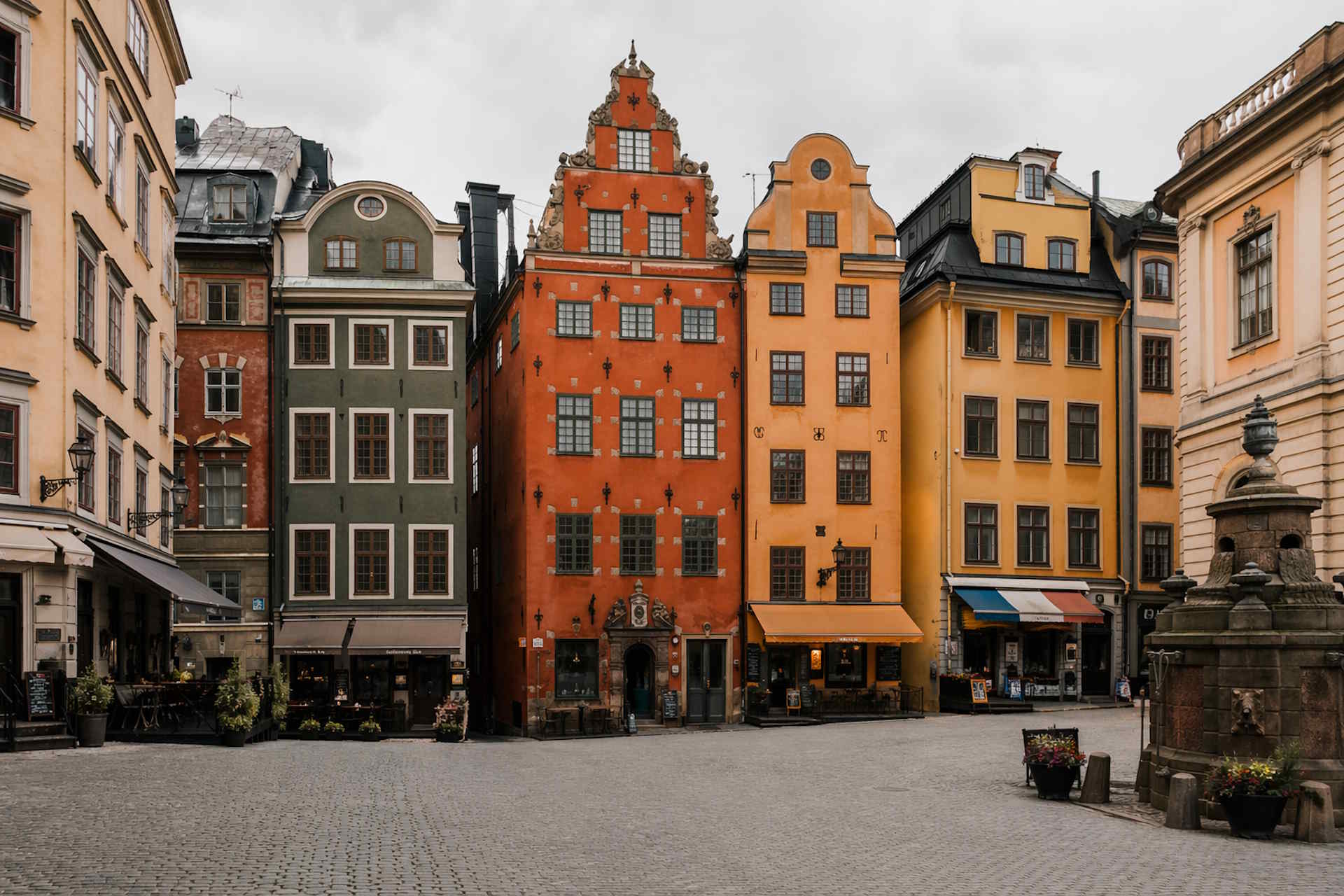
Stockholm Old Town, or Gamla Stan, is one of Europe’s best preserved medieval city centers, where architecture tells the story of the city through every alley, façade, and courtyard. A walk through the area reveals several centuries in the same neighborhood, where medieval foundations stand beside Renaissance influences, Baroque details, and later restorations. This is what makes the district more than a beautiful destination. It is a living example of how cities evolve over time.
One of the most distinctive features of Gamla Stan is its street layout. The narrow, winding lanes were created long before modern urban planning and follow the natural shape of the land rather than straight lines. Buildings were placed closely together to protect against wind and cold while making the most efficient use of limited space inside the old city walls.
Many of the buildings still contain medieval structural cores, even if their façades were redesigned in later centuries. Behind colorful plaster walls and decorative windows, there may be brickwork dating back to the fourteenth or fifteenth century. It is common for houses in Gamla Stan to show layers of history, with each generation adding new features based on changing tastes and growing wealth.
The façades are among the most memorable elements of Stockholm Old Town architecture. Shades of ochre, deep red, green, and muted orange create a warm and vibrant atmosphere throughout the year. Many buildings are narrow and tall because plots of land were limited in width. As a result, houses were built upward across several floors, often with steep roofs and small attic spaces.
The squares offer a different architectural experience. Stortorget, the oldest square in Stockholm, opens dramatically after the tight streets and is surrounded by merchant houses with decorative gables and clear influence from Hanseatic cities around the Baltic Sea. It reflects how trade and international connections shaped the appearance of the city centuries ago.
Churches and palaces add monumentality to the otherwise intimate scale of the district. Stockholm Cathedral, Riddarholmen Church, and the Royal Palace each represent different architectural ideals and periods. Together they show how religion, royal power, and public prestige left their mark on the urban landscape.
The courtyards, often hidden behind street façades, are another important part of the area’s design. These quieter spaces feature cobblestones, staircases, wells, and preserved historic details. They reveal how everyday life was organized behind the public face of the buildings, where homes, workshops, storage, and trade often existed side by side.
Materials have also played a major role in defining the character of Gamla Stan. Natural stone, brick, timber beams, and lime plaster dominate many structures. Surfaces often carry the marks of age rather than appearing overly restored, giving the district an authenticity that is difficult to recreate in newer environments.
Today, Stockholm Old Town remains a powerful example of how historic architecture can continue to function in a modern city. The area is filled with homes, shops, restaurants, and culture while preserving its historic identity. The combination of everyday life and centuries of craftsmanship makes Gamla Stan one of Stockholm’s most fascinating places.